Artificial Intelligence

GitHub Agentic Workflows – Working Implementation Part1

As part of my ongoing exploration of modern DevOps and AI‑assisted engineering practices, I recently built a Proof of Concept (POC) using the newly launched GitHub Agentic Workflows. The goal was simple but impactful: automate the generation of a daily status report by letting agents reason over repository activity and produce a meaningful summary.
 
In this blog, I’ll walk through why I chose this use case, how the agentic workflow is designed, and what I learned from the POC.

Why Daily Status Reports?

Daily status reporting is one of those activities that is essential but often repetitive:

  • Engineers manually summarize commits, PRs, and issues
  • Leads consolidate updates across repos and teams
  • Context often gets lost, and reports vary in quality

This made it a perfect candidate to test agentic workflows, where agents can:

  • Observe repository signals
  • Reason over changes
  • Generate structured, human‑readable output

What Are GitHub Agentic Workflows (In Simple Terms)?

Traditional GitHub Actions follow a deterministic, step-by-step execution model. Agentic workflows, on the other hand, introduce a more intent-driven approach:

  • You define what outcome you want
  • Agents decide how to reach that outcome
  • Agents can iterate, reason, and refine results

POC Architecture Overview

At a high level, the workflow looks like this:

  1. Trigger

    • Scheduled (daily) or manual trigger
  2. Context Collection Agent

    • Gathers commits, PRs, issues, and workflow runs
    • Focuses only on activity within the last 24 hours
  3. Reasoning Agent

    • Groups related changes
    • Filters out noise (minor version bumps, formatting-only commits, etc.)
    • Identifies themes (features, bug fixes, infra changes)
  4. Report Generation Agent

    • Produces a clean, structured daily status report
    • Outputs in Markdown for easy sharing

Designing the Agent Logic

One of the most interesting parts of this POC was thinking in terms of agent behavior, not steps.

Instead of:

  • “Fetch commits”
  • “Loop through commits”
  • “Format text”

I defined instructions like:

  • Summarize meaningful engineering progress
  • Highlight risks or blockers if detected
  • Keep the tone concise and leadership-friendly

This shift in mindset is where agentic workflows really shine.

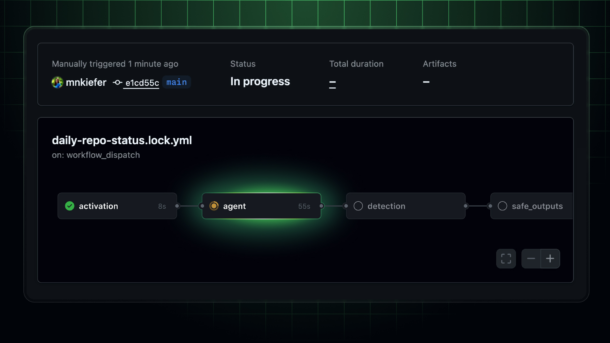
Here are the steps 

  1. Create one repo in GitHub, here I have created simple terraform code (Not a Production Grade though )
  2. Install the GitHub Agentic Workflows extension. here is the code gh extension install github/gh-aw
  3. Add daily status report workflow in your repo gh aw add-wizard githubnext/agentics/daily-repo-status 
  4. Select appropriate AI Engine as per your choice, in this demo we will choose first option i.e. GitHub Copilot CLI with agent support option
  5.  Now we need to create PAT token and paste in above CLI terminal
  6. Just generate new New fine-grained Personal Access Token and give Read only access to  Copilot Requests, generate PAT token and copy in above step
  7. This will create a new PR, just merge it from CLI
  8. The daily-repo-status.md file contains markdown description what Workflow Agent should do. 
  9. The daily-repo-status.lock.yml file contains actual Agentic Workflow Action

Sample Output: Daily Status Report

Here’s an example of the kind of report the workflow generates. Basically this GitHub Agent workflow will generate daily status report of your GitHub Repository and create a new issue:

Daily Engineering Status – 19 Feb, 2026 – https://github.com/ranglanimanish90/newinfra/issues/5

  • Project 

    • Basically report is giving generic overview of the project repository
    • What type of code it contains. E.g. in this case it is using IaC
    • Recent Activities in last 24 hours
  • Pull Request, Releases, Issues

    • How many Open PRs, closed PRs
    • New Releases v1.0 “Release v1”
    • Open Issues, closed Issues
  • Recommendation for next step

    • Terraform module updates for logging standardization
    • Testing and Validation scope
  • Critical security Alerts 

    • Check this our another daily status report https://github.com/ranglanimanish90/newinfra/issues/13
    • Here it found out that there is one hardcoded AWS Secret added in code and asking to remove it immediately. (Please note given AWS Key is dummy and added just to validate effectiveness of Agent to capture security loop holes)

The output is consistent, readable, and context-aware, without manual effort
What Worked Well

Reduced Manual Effort
The report is generated automatically, saving time for both engineers and leads.

Consistency
Same structure, tone, and level of detail every day.

Context-Aware Summaries
The agent doesn’t just list commits—it explains what changed and why it matters.

Challenges & Learnings

⚠️ Prompt Quality Matters
The clarity of GitHub Agentic Workflow agent instructions directly affects output quality. Small wording changes can significantly improve summaries.

⚠️ Noise Control
Without guidance, agents may over-report trivial changes. Explicitly defining “what is meaningful” helps a lot.

⚠️ Trust but Verify
Agentic output is powerful, but for leadership-facing reports, a quick human review still adds confidence.

Where This Can Go Next

This POC opens up several interesting possibilities:

  • Weekly or sprint-level summaries
  • Release notes auto-generation
  • Engineering health dashboards
  • Integration with internal DevOps portals or CoEs

Personally, I see strong potential for using agentic workflows as DevOps accelerators, especially in large, multi-repo environments.

Important Notes..

  • Avoid updating daily-repo-status.lock.yml file directly otherwise your GitHub Action workflow will fail.
  • If you need your Agent to work in specific way just write down details in daily-repo-status.md file and compile your code using command –> gh aw compile

ChatGPT in VSCode

As we know OpenAI’s ChatGPT has gained popularity in past few months. Microsoft has integrated the AI feature into number of their products like MS Team, PowerApps, Power Automate, PowerBI, Word, PowerPoint, Outlook, recently in Bing search engine and Edge web browser. List goes on and on.

The latest in the queue is the ChatGPT extension for VSCode. ChatGPT extension as co-pilot will help Developers to write fast and efficient code without switching the context between multiple apps.

Developers can use this free extension to Write Code, Find Bugs, Generate Comments, Optimize Code, Create Test Cases. Complete Code. Yes this extension can help you to complete half written/ incorrect code. It provide correct code snippets

It works like charm!!

Watch below video to understand the capabilities 📽️

Call OpenAI API using PowerApps and Power Automate

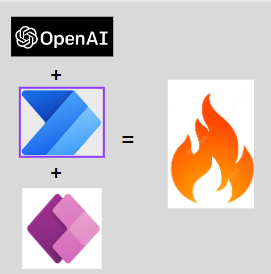
In this blog post, I will demonstrate how to consume OpenAI API from PowerApps via PowerAutomate. It will be kind of ChatGPT3 experience where user can put forward any question in PowerApps, OpenAI will answer that.

Before we begin this, I would highly recommend to go through my first blog on OpenAI account setup and how to create API Key.

Here is the URL – https://kloudscoop.com/getting-started-with-openai-api-and-postman/

1. Create New Flow in PowerAutomate
  • Go to the PowerAutomate
  • Create new ‘Instant cloud flow’ 
  •  Initialize the variable, this would be the question which will get passed from PowerApps.
  •  Next insert HTTP action, which will call to OpenAI end point. In Header section put Authorization – Bearer Token and in Body section pass on the JSON as shown below. Please note here prompt would be the dynamic question variable initialized above.
  • Finally return respose to PowerApps, this is the response or answer which we will get from OpenAI API.
  • You need to parse JSON and the experssion would be outputs(‘Q&AAPI’)?[‘body’]?[‘choices’][0]?[‘text’]
  • Save the Flow
 
2. Create New PowerApps
  • Go to the PowerApps and create new App
  • Note: We will not go in detail/step by step process to create PowerApps we will stick to the purpose of this Post.
  • Add 3 lables (Question, Answer and one lable to populate answer from OpenAI ), textbox (ask the question) and button
  • On click of button i.e. on OnSelect property call your PowerAutomate Flow as shown below and in parameter pass question from textbox
  • Save the PowerApps. You are done.
  • Now let’s the magic begin!!
  • See this video, where OpenAI is answering our questions on Classification, Translation, General questions

Getting Started with OpenAI API and Postman

Recently there is a big wave about Artifical Intelligence from Open AI, you may see people have started talking about Chat GPT-3 (Generative Pre-training Transformer). As name suggest it is one of the largest language Pre-Trained model which uses deep learning to produce human like answers.

Did you Know?

Open AI’s GPT-3 is the largest Language Model having 175 BN parameters, 10x more than that of Microsoft’s Turing NLG

In this article I will show you the process to leverage Open AI APIs, so let’s begin:

1. Create New Account on OpenAI web site
 2. Get API Keys
  • Click on Personal menu link in top right ribbon 
  • Click on ‘View API keys’
  • Click on ‘Create new secret key’ button, it will generate new API secret key
  • It will generate new API key, something like in this format sk-<random text>. Copy this key and keep at safe place. You would need this to call OpenAI APIs
  • Important Note: As of writing this blog, OpenAI does not provide official API for ChatGPT. One can use an existing models to get answers that are somewhat similar to the ChatGPT capabilities: Davinci.
3. Call OpenAI API with Postman
  • Open Postman Application
  • Enter URL as https://api.openai.com/v1/completions
  • Select POST HTTP method
  • In Authorization tab, select TYPE as ‘Bearer Token’
  • Paste API key (from Step 2) in token field
  • Now we need to send query/prompt in API body, so to do that select Body tab, select raw format as JSON and paste your JSON like this.
  • In this example we are using text-davinci-003 model and asking it to correct English Grammer in given sentense
  • Once done, click on Send button
  • The JSON response will return sentense with correct English Grammer.
 
Congratulations!! with this you learned how to consume OpenAI API using Postman client. Similarly you can explore many more features on OpenAI website on examples page. 
This includes Classification, Translation, Code etc.